

Scams Targeting Older Adults
How to Recognize, Avoid, and Report Fraud
Updated: September 2026
Written by: Golden Living Today Editorial Team
Sources reviewed: September 2026
Scammers use phone calls, emails, text messages, social media, and other methods to steal money or personal information. Learning the warning signs and verifying unexpected requests can help protect you and your loved ones.
💻 Technology & Safety Disclaimer: The information provided in this article is for general educational purposes only. Technology, security threats, scams, and online services change frequently. Always use caution when sharing personal or financial information and verify suspicious communications directly with the organization or agency involved.
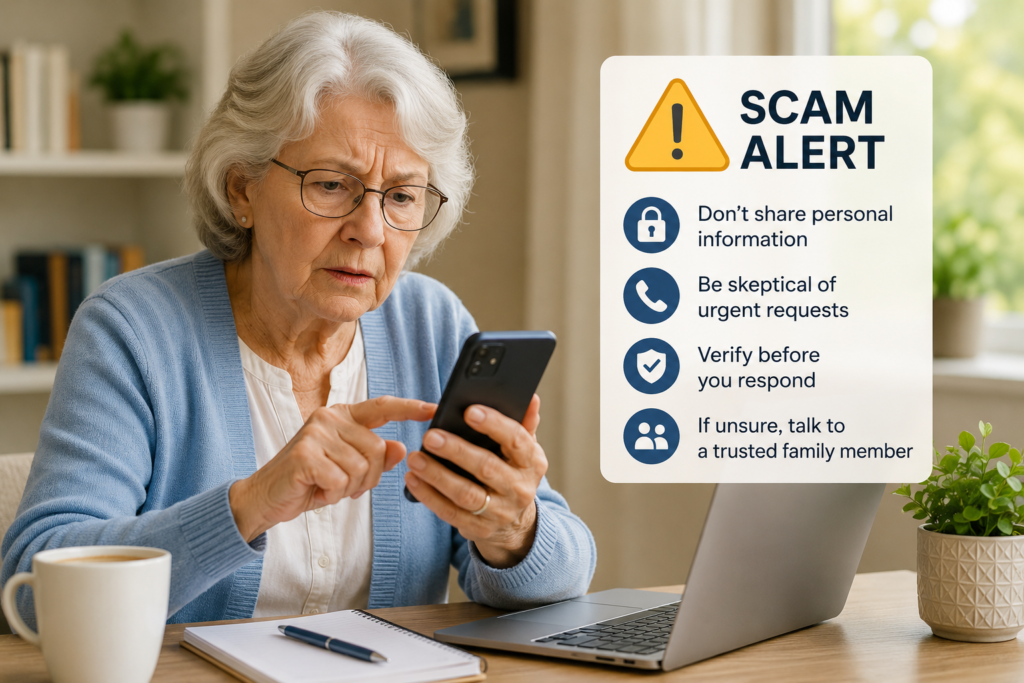
This guide explains several common scams targeting older adults and how to protect yourself and your loved ones.
In This Article…
• Common Warning Signs of a Scam
• Government and Business Impersonation Scams
• Investment and Cryptocurrency Scams
• Medicare and Health Insurance Scams
• Romance and Relationship Scams
• Grandparent and Family Emergency Scams
• Protecting Your Personal Information

Common Warning Signs of a Scam
Many scams share similar warning signs. Be cautious if someone:
• Pressures you to act immediately
• Requests payment using gift cards, wire transfers, or cryptocurrency
• Asks for personal information such as your Social Security number or banking details
• Claims you have won a prize but must pay a fee to receive it
• Threatens legal action, arrest, or loss of benefits
• Tells you to move your money to another account to “protect” or “secure” it
When in doubt, slow down and verify the information independently.

Phone Scams
Scammers often pretend to be:
• Government agencies
• Medicare representatives
• Banks or credit card companies
• Utility companies
• Technical support representatives
Do not provide sensitive personal or financial information in response to an unexpected call until you have verified who is calling. Hang up and contact the organization directly using a phone number you know is legitimate.
Do not trust caller ID alone. Scammers can disguise the name or number displayed on your phone. Never share account-verification codes or allow an unexpected caller to access your phone or computer remotely.
Government and Business Impersonation Scams
Scammers may pretend to represent Social Security, the IRS, law enforcement, a bank, a utility company, Amazon, or another familiar organization.
They may claim that your account, identity, benefits, or money is in danger. They may then tell you to transfer money, withdraw cash, purchase gift cards or cryptocurrency, or keep the situation secret.
Hang up and contact the organization yourself using its official website, mobile app, account statement, or the phone number printed on the back of your card.
Tech-Support Scams
Tech-support scammers may use unexpected phone calls, emails, text messages, or pop-up warnings claiming that your computer has a virus or security problem.
Do not call a number displayed in an unexpected warning, click its links, or give someone remote access to your device. If you believe your device has a problem, contact the manufacturer or a trusted technology professional using contact information you find independently.
Investment and Cryptocurrency Scams
Scammers may promise guaranteed profits, unusually high returns, or a special investment opportunity with little or no risk. Some build a friendship or romantic relationship before offering investment advice.
Be cautious if someone:
• Pressures you to invest immediately
• Promises guaranteed returns
• Directs you to an unfamiliar investment website or app
• Asks you to pay with cryptocurrency
• Shows apparent profits but will not allow you to withdraw your money
• Demands additional fees or taxes before releasing your funds
Before investing, research the person and company independently. Never invest solely on the advice of someone you met online.
Email and Internet Scams
Fraudulent emails and websites may appear legitimate.
Protect yourself by:
• Avoiding suspicious links
• Not downloading unknown attachments
• Verifying website addresses carefully
• Using strong passwords
• Keeping software updated
If an email seems suspicious, delete it or verify it with the organization directly.
Medicare and Health Insurance Scams
Scammers may pretend to represent Medicare, a health insurance company, or another government program.
Medicare, or someone representing Medicare, will only call and ask for personal information in limited situations—for example, when returning your call after you’ve joined a plan, reported fraud, or left a message for Medicare.
Protect yourself by:
• Never sharing your Medicare number with an unexpected caller
• Refusing offers of “free” medical equipment that require your Medicare information
• Reviewing Medicare claims and insurance statements for services you did not receive
• Hanging up and calling Medicare directly using its official number if you are uncertain
• Reporting suspicious charges or possible misuse of your Medicare number
Romance and Relationship Scams
Scammers may build trust through social media, dating websites, or online communities before asking for money.
Be cautious if someone:
• Quickly declares strong feelings
• Avoids meeting in person
• Repeatedly requests financial assistance
Never send money, gift cards, cryptocurrency, or financial account information to an online love interest who asks for financial help.
Grandparent and Family Emergency Scams
In this scam, a criminal pretends to be a grandchild, relative, lawyer, police officer, or medical professional dealing with an emergency.
The caller may claim that a loved one:
• Was arrested
• Was involved in an accident
• Is in the hospital
• Needs money immediately
• Does not want other family members to know
Scammers may use artificial intelligence to imitate a loved one’s voice. Do not trust the voice or caller ID alone. Hang up and call your relative directly using a phone number you already know. If you cannot reach the person, contact another trusted family member before sending money.
Protecting Your Personal Information
To reduce your risk:
• Shred sensitive documents
• Monitor financial accounts regularly
• Use strong, unique passwords
• Enable multifactor authentication (MFA), sometimes called two-step verification, when available.
• Be cautious when sharing information online
What to Do If You Suspect a Scam
If you believe you have been targeted or have already sent money:
- Stop sending money or sharing additional information.
- Save emails, text messages, receipts, phone numbers, payment records, and screenshots.
- Contact your bank, credit-card company, payment app, gift-card company, cryptocurrency platform, or wire-transfer service immediately. Explain that the payment was connected to a scam and ask whether it can be stopped or reversed.
- Change passwords for any accounts that may have been compromised. Use new, unique passwords and enable multifactor authentication.
- If someone accessed your computer or phone, disconnect the device from the internet and contact a trusted technology professional.
- If your Social Security number or other identifying information was exposed, check your credit reports and consider placing a credit freeze.
- Report the incident to the appropriate government agency.
Quick action may reduce further losses, although recovering money is not always possible.
Where to Get Help
Depending on the situation, consider contacting:
• Your bank, credit union, credit-card company, or payment provider
• The Federal Trade Commission’s fraud-reporting service
• The IdentityTheft.gov identity theft recovery service
• The FBI Internet Crime Complaint Center for internet-enabled fraud
• Medicare at 1-800-MEDICARE for suspected Medicare fraud
• Call 911 if you or someone else is in immediate danger. For non-emergency theft, threats, or suspected criminal activity, contact your local police department.
• Adult Protective Services if an older adult is being financially exploited by a caregiver, relative, or another person in a position of trust
• A trusted family member, friend, caregiver, or financial professional
• The National Elder Fraud Hotline at 1-833-FRAUD-11 (1-833-372-8311) for assistance reporting fraud affecting an older adult
Reporting a scam may help investigators identify patterns, warn other consumers, and pursue fraudulent operations.

🌿 Golden Moment
Staying safe isn’t about being suspicious of everyone—it’s about being informed and trusting your instincts. A few thoughtful precautions today can help protect your finances, your identity, and your peace of mind.
Related Articles
Looking for more information about safety, healthcare, and protecting your financial well-being?
Explore these related articles:
• Technology & Safety Basics for Seniors
Learn practical ways to use smartphones, computers, online accounts, and other technology more safely and confidently.
• Understanding Medicare: A Beginner’s Guide
Get a clear overview of Medicare Parts A, B, C, and D, along with helpful information about enrollment, coverage, and costs.
• Understanding Medicaid: A Beginner’s Guide
Learn how Medicaid works, who may qualify, what services may be covered, and where to apply for assistance.
• Managing Money in Retirement: A Practical Guide
Discover practical ways to create a retirement budget, manage everyday expenses, protect your savings, and prepare for unexpected costs.
📚 Sources & Further Reading
• Federal Trade Commission — Scams Against Older Adults
• Federal Bureau of Investigation — Scammers Target Older Adult Victims
• Federal Trade Commission — Romance Scams
• Medicare.gov — Reporting Medicare Fraud and Abuse
• IdentityTheft.gov — Identity Theft Recovery Resources
• FBI Internet Crime Complaint Center — Elder Fraud
• Cybersecurity and Infrastructure Security Agency — Secure Our World
• Federal Trade Commission — How to Avoid a Government Impersonation Scam
• Federal Trade Commission — How to Spot, Avoid, and Report Tech-Support Scams
• Federal Trade Commission — Investment Scams
• Federal Trade Commission — Scammers Use AI to Enhance Their Family Emergency Schemes
• U.S. Department of Justice — National Elder Fraud Hotline / Elder Justice Initiative